 Coperion
Open navigation
Coperion
Open navigation

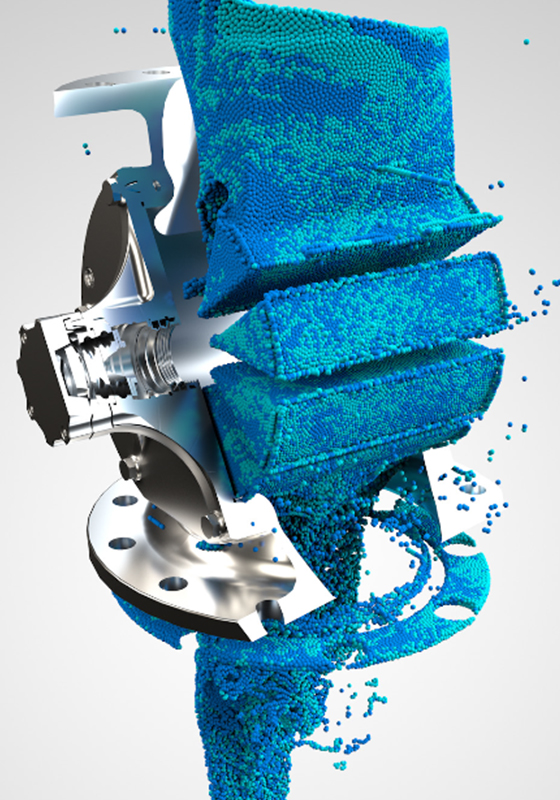
By metering powders or granules accurately while minimizing air leakage, rotary valves help processes run safely, efficiently, and reliably. But how exactly does a rotary valve work, and why does it play such an important role in industrial processes?
The Basic Working Principle of a Rotary Valve
A rotary valve consists of a rotating rotor (also called a cell wheel) with multiple chambers or pockets. This rotor is mounted inside a precisely engineered valve housing that features an inlet at the top and an outlet at the bottom.
As the rotor turns, bulk materials such as powders, granules, or pellets are metered into its open chambers from the inlet. The rotation of the valve then conveys the material downward through the housing and discharges it continuously through the outlet.
This simple but highly effective mechanism enables controlled feeding, dosing, or discharge of material from silos, hoppers, cyclones, and filters into downstream processes.
Airlock Function: Feeding and Sealing in One Device
In pneumatic conveying systems, rotary valves perform two essential functions: they act simultaneously as a feeder and as an airlock.
The precise clearances between the rotor blades and the valve housing minimize the flow of air or gas through the valve, even when there is a pressure difference between the inlet and outlet sides.
This dual functionality allows the rotary valve to:
- Feed material into the conveying line at a steady, controlled rate
- Maintain system pressure, preventing unwanted air leakage or pressure loss
- Ensure dust-tight operation, protecting product quality and the surrounding environment
By keeping a consistent material flow while sealing against pressure, the rotary valve enables smooth, energy-efficient conveying in both positive and negative pressure systems.
Explosion Protection Function of Rotary Valves (ATEX-Certified)
A rotary valve can serve as an ATEX-certified explosion protection system when it is specifically engineered to prevent the propagation of explosions within industrial plants. As a critical explosion isolation device, the valve must demonstrate high pressure resistance and ensure that flames, sparks, or ignition sources cannot pass from one side of the system to the other.
This explosion isolation capability effectively contains potential explosions within a defined process area, significantly reducing the risk of damage to equipment and ensuring plant safety. ATEX-certified rotary valves are therefore essential components in industries handling combustible dusts or hazardous materials, providing reliable passive explosion protection and compliance with safety regulations.
Key Components of a Rotary Valve
A typical rotary valve includes several precisely engineered components that ensure durability and performance:
- Rotor (Cell Wheel): An element that carries material through the valve pockets.
- Valve Housing: Encloses the rotor and maintains tight tolerances for effective air sealing.
- End Covers and Bearings: Provide mechanical stability and support smooth rotor rotation.
- Drive Mechanism: Powers the rotor at a controlled speed to regulate the material feed rate.
Rotary Valve Solutions by Coperion
At Coperion, we design and manufacture high-precision rotary valves for a wide range of materials and operating conditions. From powder handling to granular conveying, our rotary valves are built to ensure maximum efficiency, safety, and product integrity in every application. Our experts can help you select the right rotary valve configuration for your specific process.