 Coperion
Open navigation
Coperion
Open navigation

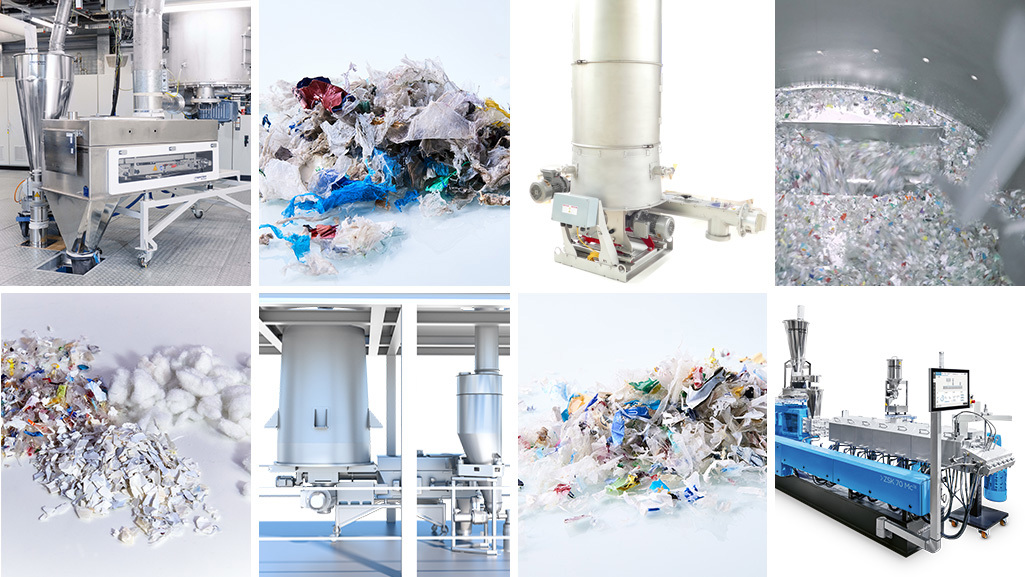
Why is it so difficult to recycle fluffy plastics such as shredded thin films?
One thing is clear: In order to increase market share, plastics recycling must be possible at high throughputs. While good recycling solutions already exist for hard raw materials from PE, PP, ABS or PS, the recycling and handling of films, flakes, foams, textile fibers or pellets remains challenging.
Processing recycled plastics with low bulk density frequently leads to irregular material flow in the recycling process, with the result that recycling machinery can't perform to its full potential.
When recycling “lightweight” flakes or fibers, it's not enough to optimize a single component such as a silo or a diverter valve to handle fluffy material. Instead, the path of the material must be considered throughout the entire recycling process. This includes grinding, washing, separating, drying, as well as storing, conveying, discharging and feeding, extruding, homogenizing, compounding and pelletizing.
Where exactly do the challenges lie in recycling lightweight films or fibers?
Film flakes and fibers have a very low bulk density, making them very voluminous. If a buffer hopper is necessary in the recycling process, then automatically very high storage volumes are required. Transporting material from the point where the waste stream arises to the recycling facility can also add significant cost.
Additionally, such highly fluffy materials are very hard to control when being conveyed and introduced into the recycling extruder. The challenge and the goal for recycling waste plastics is a consistent material flow that is as high as possible, so that the recycling equipment can fully exploit its performance potential.
However, high throughput is not the only factor of importance when recycling flakes and fibers. The quality of the recompound that is manufactured from films and fibers, the energy consumption of the recycling plant, and its maintenance costs also play important roles when evaluating the process.
Coperion relies on gravimetric feeders especially for recycling fluffy materials. Why? And what are the advantages versus volumetric feeders?
In Coperion recycling lines, we rely on gravimetric feeders to allow stable, high throughputs and consistent, very high product quality.
Fundamentally, two feeding methods are considered for recycling, volumetric and gravimetric, whereby each technology has its own specific advantages and areas of application.
Volumetric feeding brings the material into the process at a steady volume flow rate when bulk density is consistent. This method can be advantageous when the focus is on a simple process construction or variations in bulk density are negligible. It is less precise but does provide cost advantages at time of purchase.
Gravimetric feeding is based on weight measurement, and is characterized by its outstanding accuracy. It is ideal for applications where material infeed accuracy and consistency is critical and high product quality needs to be achieved. Even in the event of deviations in bulk density or material composition, gravimetric feeders reliably ensure accurate material infeed and thus high endproduct quality. Gravimetric feeding is the prerequisite for both melting and compounding waste plastic within one process step or in one extruder.
Specifically, that means for our plastic recycling lines that with gravimetric feeders, we ensure that our twin screw recycling extruders are fed with absolute precision. The material stream is completely uniform, for very low feed rates of under 100 kg/h all the way up to high rates well over 10 t/h. Using gravimetric feeders, we control exactly the quantity of additives being fed downstream for compounding. Moreover, gravimetric feeders ensure that the entire plastic recycling process is reproducible at any time.
By using gravimetric feeders in our recycling solutions, melting and compounding can take place in just one twin screw extruder, resulting in energy savings of up to 50% compared to two-step recycling processes using single screw extruders.
How does Coperion solve the difficulty of intermediate storage and discharge of low bulk density materials before they enter the feeder and the recycling extruder?
Here, we benefit from the fact that Coperion has expertise in every part of the process. Coperion brings together experts in mechanical pre-treatment of waste plastic, bulk material handling, feeding and extrusion and compounding. We know which properties a material possesses at what point in a given process step. And precisely with this expertise, we can convey, store, feed and extrude every product – even when material properties fluctuate, we optimally adjust every interface to the needs of the end customer.
The interplay of our competencies becomes very clear in intermediate storage, discharge and feeding within the extrusion process. We know the properties of freshly washed and shredded waste plastic inside and out and, when needed, we can determine the exact bulk material properties in our own laboratories using the most modern measurement methods. We know how material is conveyed, dried, and intermediately stored. And we have the know-how to be able to discharge even the fluffiest materials from intermediate storage and evenly introduce them into the recycling extruder at high feed rates.
Our portfolio offers a variety of different technologies for storage, discharge and feeding. We define the optimal combination of these recycling technologies, depending upon the material properties, so that compounds with constant product quality at the highest level can be manufactured with Coperion recycling equipment — and in every desired throughput range.
How do I know what the right combination of recycling technologies is?
At our Coperion location in Weingarten, we operate our Recycling Innovation Center. Every technology in the Coperion Group portfolio is available there to our customers for testing.
That also applies to the interplay between intermediate storage, discharging, and feeders. Our customers can send their original product for recycling to us, and together with our experts, they can comprehensively test the performance while discharging and feeding.
We process films, fibers, flakes or pellets, we combine technologies, and we determine the optimal equipment configuration to achieve the desired feed rate. In this way, our customers get certainty prior to investment that our technologies will lead to the desired result.
